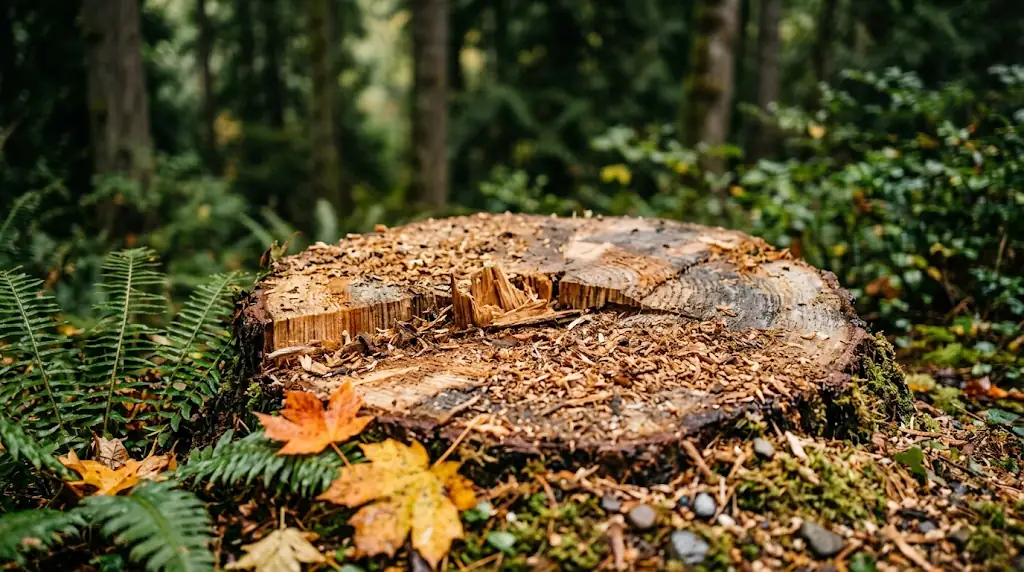
You should grind the stump 6 to 12 inches below grade or extract it completely, because leaving a raw tree stump in East King County creates a breeding ground for wood-destroying pests and fungal root pathogens. While natural decomposition sounds convenient, the cool, wet climate of Western Washington causes unmanaged stumps to harbor carpenter ants, dampwood termites, and subterranean honey fungus (Armillaria) that readily infects adjacent landscape trees.
Stump Management Options: Grinding vs. Excavation vs. Leaving It
Property owners have three primary paths following a tree removal:
| Management Method | Execution Depth | Best Use Case | Typical East King County Cost | Impact on Replanting |
| Standard Stump Grinding | 6 to 12 inches below grade | Lawns, standard garden beds, driveway edges | $150 – $500 ($3 to $5 per diameter inch) | Allows lawn sod, shallow shrubs, or perennial beds |
| Deep Stump Grinding | 18 to 24 inches below grade | Preparing site for new tree planting or pathways | $350 – $750 | Allows medium-rooting shrubs or small replacement trees |
| Full Root Excavation | Full root ball extraction (excavator) | Building foundations, retaining walls, ADU pads | $800 – $2,500+ | Clears 100% of subterranean root mass for civil building |
| Leaving It in Place | Cut flush with grade | Designated steep slopes, NGPEs, erosion zones | $0 (included in drop) | Native understory will naturally integrate over 10–20 years |
4 Risks of Leaving a Tree Stump in Western Washington
Leaving a stump in your yard creates immediate biological and structural liabilities for Eastside properties:
1. Dampwood Termites & Carpenter Ant Infestations
Western Washington is home to active colonies of dampwood termites (Zootermopsis angusticollis) and western carpenter ants (Camponotus modoc). As rain saturates the dead sapwood, softening the outer rings, these insects colonize the core. Once a satellite colony establishes in a residential yard stump, foraging worker ants will bridge the gap to nearby wood structures, decks, and home framing within 24 to 36 months.
2. Honey Fungus (Armillaria) Transmission
Armillaria root rot—commonly recognized in autumn by dense clusters of honey-colored mushrooms around old stumps—is a virulent soil-borne pathogen across King County. The fungus feeds on the dying root system and produces black, cord-like rhizomorphs (fungal strands) that travel through the soil to parasitize the healthy root networks of nearby Douglas firs, hemlocks, rhododendrons, and ornamental maples. Grinding the stump and exposing the wood to oxygen halts the primary fungal food engine.
3. Persistent Sucker Growth and Sprouting
Species common to the Pacific Northwest like Bigleaf Maple, Red Alder, Cottonwood, and Birch rarely die when cut down. The intact root system continues to push sap upward, generating dozens of aggressive vertical suckers (epicormic shoots). Left unmanaged, these suckers become multi-stemmed brush thickets that steal moisture and nutrients from manicured lawn turf and garden beds.
4. Tripping Hazards and Mower Blade Destruction
A raw stump cut 2 to 4 inches above the turf creates liability risks for family and guests, while hidden surface roots warp lawnmower blades, break drive belts, and destroy mower decks.
Underground Utilities: The Mandatory 811 Dig Law
Stump grinding involves high-speed carbide cutting teeth rotating at 1,500+ RPM beneath the soil line.
Under Washington State’s Dig Law (RCW 19.122), stump grinding qualifies as excavation. You or your tree contractor must contact the Washington 811 utility locating center at least two full business days prior to grinding.
                   WASHINGTON 811 COLOR CODE REFERENCE

   [ RED ] ────────── Electric Power Lines (PSE)
   [ YELLOW ] ─────── Gas, Oil, or Steam Lines (PSE Gas)
   [ ORANGE ] ─────── Communication, Cable, Fiber Optic
   [ BLUE ] ───────── Potable Water Mains
   [ GREEN ] ──────── Sewer and Stormwater Drain Lines
   [ WHITE ] ──────── Proposed Grinding / Excavation Zone
- Public vs. Private Lines: 811 locators mark only public utility lines up to the meter. They do not mark private lines such as low-voltage landscape lighting, invisible dog fences, French drains, or irrigation pipes. Property owners must alert contractors to private line routes before work begins.
- Tolerance Zones: Grinding within 18 inches of a marked gas line or 24 inches of a high-voltage electrical conduit requires hand-digging or hydro-vacuum excavation to prevent catastrophic punctures.
What to Do With the Stump Grindings: Mulch vs. Disposal
Grinding a 24-inch conifer stump generates approximately one to two cubic yards of wood chips blended with mineral soil.
┌────────────────────────────────────────────────────────────────────────┐
│                   HOW TO HANDLE POST-GRINDING DEBRIS                   │
├───────────────────────────────────┬────────────────────────────────────┤
│ REUSING ON-SITE AS MULCH          │ WHEN TO HAUL OFF-SITE              │
├───────────────────────────────────┼────────────────────────────────────┤
│ • Excellent weed-suppression      │ • Stump was infected with fungal   │
│   barrier for informal pathways   │   rot (Armillaria or Phellinus)    │
│ • Compost in a secondary pile     │ • Lawn restoration is planned      │
│   for 6 months before garden use  │   immediately in the footprint     │
│ • Ring around mature ornamental   │ • Wood volume creates a massive,   │
│   trees (keep 4" off the trunk)   │   unsightly mountain in small yard │
└───────────────────────────────────┴────────────────────────────────────┘
The Nitrogen Depletion Fact: Never plant grass seed or tender bedding flowers directly into fresh grindings. As bacteria and soil microbes break down raw wood chips, they consume massive amounts of nitrogen from the surrounding topsoil, stunting new plant growth.
Steps for Lawn Restoration After Grinding:
- Shovel Out the Mixture: Remove the bulk of the blended wood-and-soil shavings down to 4 inches below the surrounding grade.
- Backfill with Native Loam: Fill the depression with a 70/30 blend of clean topsoil and screened compost, tamping down lightly to accommodate settling.
- Mound Slightly: Grade the soil roughly 1 inch higher than the surrounding lawn surface to prevent a low puddle zone once the soil compacts.
- Seed or Sod: Apply a Pacific Northwest perennial ryegrass/fine fescue seed blend, top with peat moss, and water daily.
The Critical Exception: Steep Slopes and Critical Area Stumps
If your tree was removed on a designated steep slope (slopes of 15% to 40%+ under Kirkland Zoning Code Chapter 85 or King County Title 21A), stump grinding is strictly prohibited.
In these geologically sensitive areas:
- The tree trunk must be cut flush with the soil line.
- The subterranean root system must be left intact to hold the glacial till together and prevent slope failure.
- The city often mandates chemical girdling or biological treatments to kill sprouting shoots without disturbing the anchoring root grid.
Complete Stump Removal Solutions in East King County
Whether you need deep grinding for replanting, complete site prep for an addition, or careful mechanical chipping near property lines, handling the stump properly finishes the job safely. Kirkland Tree Removal delivers complete commercial-grade stump grinding, 811 utility clearance compliance, and site backfilling across Kirkland, Bellevue, and greater East King County. To schedule stump grinding or complete hazard tree extraction, connect with our crew through the Kirkland Tree Removal Contact Page.