Removing a tree on or near a steep slope in East King County requires a specialized Critical Area Permit, and standard residential tree removal allowances do not apply. Because tree roots provide the tensile strength holding glacial soils together, local codes strictly prohibit cutting down trees on slopes of 15% to 40% grade or greater without formal geotechnical review and mandatory root retention.
What Counts as a “Steep Slope” in East King County?
Eastside municipalities regulate slopes under their Critical Areas Ordinances (CAO) based on percentage of inclination and vertical elevation change:
| Jurisdiction | Governing Critical Area Code | Steep Slope Definition | Required Top-of-Slope Buffer |
| City of Kirkland | KZC Chapter 85 | Slopes of 15% or greater (Landslide Hazard Area) | Minimum 10 to 50 feet based on geotech evaluation |
| City of Bellevue | LUC 20.20.730 | Slopes of 40% or greater with 10+ feet of rise | Standard 50-foot buffer from top and toe of slope |
| City of Redmond | RMC 21.64 | Slopes of 40% or greater with 10+ feet of rise | Standard 50-foot buffer |
| Unincorporated King County | KCC 21A.24.310 | Slopes of 40% or greater with 10+ feet of rise | 50-foot buffer (can be modified by geotechnical study) |
Why Standard Tree Removal Allowances Do Not Apply
On typical flat residential parcels, East King County homeowners may take down a limited number of significant trees each year using a simple online notification.
This allowance is void if your parcel contains a mapped critical area. Under Kirkland Zoning Code 95.20 and King County Title 21A, standard tree allowances cannot be used in:
- Geologically Hazardous Areas (landslide and erosion hazard zones)
- Standard steep-slope buffers (the flat ground immediately above or below the slope)
- Native Growth Protection Easements (NGPE) or Critical Area Tracts
- The Holmes Point Overlay (HPO) in Kirkland along the western slopes of Finn Hill
Cutting any regulated tree within these zones without a Critical Area review constitutes an immediate Class 1 civil violation.
The 4 Non-Negotiable Rules for Steep-Slope Tree Removal
If an arborist identifies an active structural hazard on a steep slope, the removal must follow strict engineering and biological guidelines:
┌────────────────────────────────────────────────────────────────────────┐
│                   STEEP SLOPE TREE REMOVAL PROTOCOL                    │
├───────────────────────────────────┬────────────────────────────────────┤
│ MANDATORY CODE REQUIREMENTS       │ STRICTLY PROHIBITED PRACTICES      │
├───────────────────────────────────┼────────────────────────────────────┤
│ • Flush-cut trunk at grade level  │ • Stump grinding or root pulling   │
│ • Retain 100% of the root system  │ • Heavy machinery tracking on slope│
│ • Create a 10–15 ft "Wildlife     │ • Broadcast clearing of native     │
│   Snag" if structurally viable    │   understory (salal, sword fern)   │
│ • Plant deep-rooting native stock │ • Dragging heavy log rounds across │
│   for long-term slope anchoring   │   exposed slope faces              │
└───────────────────────────────────┴────────────────────────────────────┘
1. Zero Root Disturbance (No Stump Grinding)
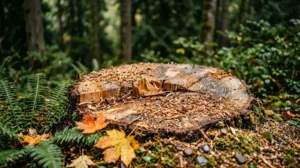
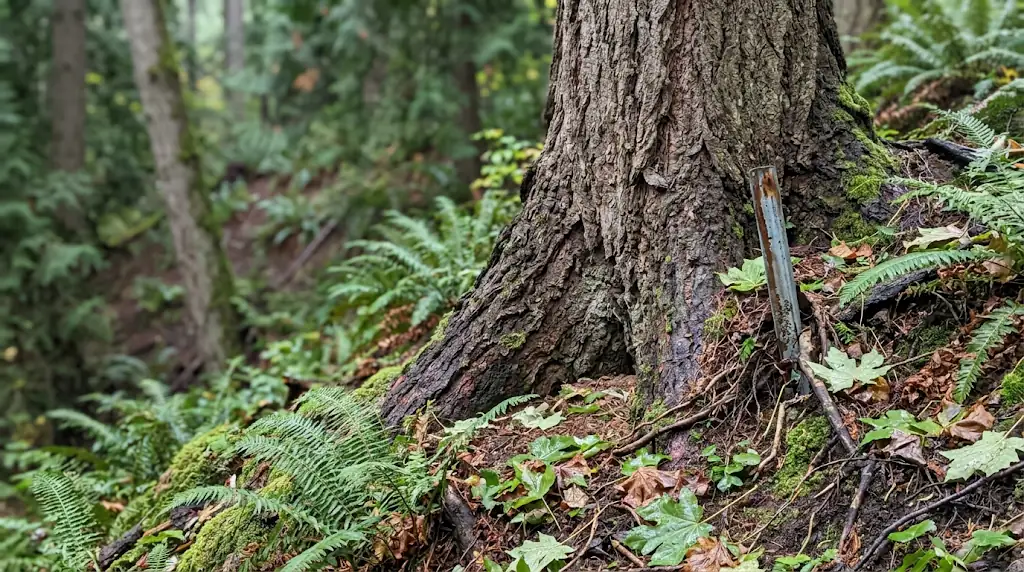
Root systems are the mechanical anchors preventing soil shear. Grinding or excavating a stump on a steep slope loosens consolidated soil and creates drainage channels that accelerate mudslides during heavy winter atmospheric rivers. Codes mandate that trees be cut flush with the soil line, leaving the entire root flare intact to decay slowly while replacement root systems establish.
2. The “Wildlife Snag” Mandate
Both Kirkland and King County codes require arborists to convert hazard trees in critical areas into wildlife snags whenever feasible. Instead of taking the entire tree down to the dirt, the contractor cuts off hazardous upper limbs and leaves a 10 to 20-foot standing trunk. This reduces top-heavy wind resistance, stabilizes the root core, and provides habitat for native woodpeckers and raptors.
3. Geotechnical Engineer Concurrence
When a tree on an active landslide hazard area must be dismantled, cities routinely require dual sign-offs:
- An ISA Tree Risk Assessment Qualified (TRAQ) arborist must prove the tree is structurally compromised, dead, or diseased.
- A licensed Washington State Geotechnical Engineer (PE) must confirm that removing the tree’s canopy and transpiration capacity will not cause slope failure or alter groundwater drainage.
4. Technical Rigging & Aerial Lifting
Dropping heavy trunk rounds directly onto a hillside can gouge topsoil and trigger slope unraveling. Tree services working on Eastside slopes must use aerial rigging, crane picks, or specialized high-lead zip lines to lift cut wood straight up and away from the hillside to a roadside staging area.
How Trees Protect King County Slopes
Understanding the role of mature evergreens explains why municipal planners protect them so aggressively:
               HOW MATURE CONIFERS STABILIZE STEEP SLOPES

          [ Rainfall Interception ] ──── Up to 40% of winter precipitation
                     │                   evaporates from needle canopy before
                     ▼                   ever reaching the ground.
             ┌───────────────┐
             │ Douglas Fir / │
             │ Western Cedar │
             └───────┬───────┘
                     │
          [ Hydrologic Pumping ] ────── Transpires hundreds of gallons of soil
                     │                   water daily, preventing soil saturation.
                     ▼
         ═════════════════════════ (Ground Level)
               ╱     │     ╲
              ╱      │      ╲
   [ Lateral Root Interlocking ] ────── Interlocking root networks act as rebar,
              ╲      │      ╱            binding loose glacial till to bedrock
               ╲     │     ╱             or dense hardpan layers below.
When a large evergreen is removed from a hillside, its transpiration stops immediately. Within 3 to 5 years, the underground root system rots away, drastically increasing landslide susceptibility unless replacement vegetation is actively managed.
Required Mitigation: Steep-Slope Replanting Ratios
When a permit to remove a tree on a steep slope is granted, the city enforces a binding restoration and revegetation plan:
- Conifer Replacement: Removed trees must be replaced with native, deep-rooting species. Common approved species include Douglas Fir (Pseudotsuga menziesii), Western Red Cedar (Thuja plicata), and Pacific Madrone (Arbutus menziesii).
- Understory Stabilization: Ground disturbed during the work must be replanted with native stabilization shrubs such as Salal (Gaultheria shallon), Sword Fern (Polystichum munitum), and Oceanspray (Holodiscus discolor).
- Performance Monitoring: Homeowners are often required to post a financial performance bond guaranteeing an 80% plant survival rate over a 3-to-5-year monitoring period.
Penalties for Illegal Cutting on Steep Slopes
Because unpermitted clearing on hillsides threatens neighboring properties and public roads below, code enforcement in East King County is aggressive:
- Kirkland: Fines reach up to $1,000 per caliper inch for unpermitted removals in geologically hazardous areas, plus mandatory engineered slope remediation.
- Emergency Geotechnical Orders: The city can issue emergency remediation orders forcing the homeowner to immediately hydroseed, install geogrid fabric, or erect retaining structures at their own expense.
- Stop Work Orders: Immediate red-tagging of all active construction, renovations, or landscape projects on the parcel.
Specialized Slope Tree Management in East King County
Working on steep terrain along Lake Washington, Cougar Mountain, or Finn Hill requires specialized low-impact rigging, crane support, and rigorous adherence to municipal critical area codes. Kirkland Tree Removal works directly with ISA-certified TRAQ arborists and local geotechnical engineers to navigate Kirkland and King County Critical Area Permits, execute low-impact technical removals, and install compliant slope-stabilizing replantings. If you have concerns about a leaning or hazardous tree on sloped ground, schedule an on-site evaluation through the Kirkland Tree Removal Contact Page.