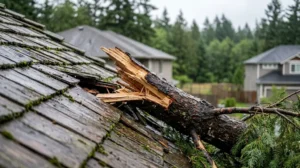
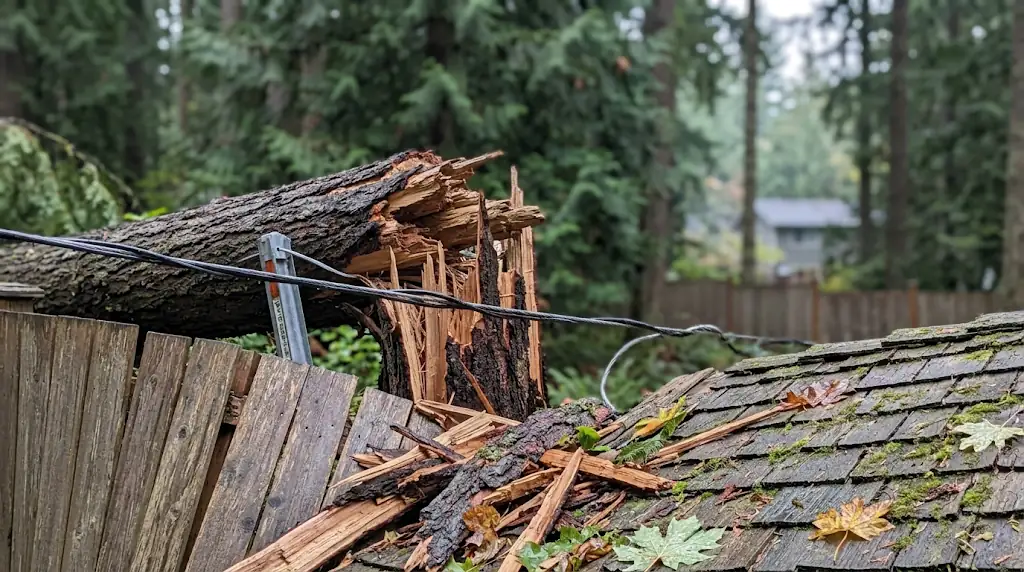
Under Washington State law, you and your own homeowner’s insurance policy are almost always responsible for paying for damage when a neighbor’s tree falls onto your property. The sole legal exception occurs when you can prove negligence: the neighbor knew—or reasonably should have known—that the tree was diseased, dead, or structurally compromised prior to the failure and failed to take corrective action.
The Core Rule: “Act of God” vs. Documented Negligence
Washington courts apply common law premises liability to falling tree damage. Liability follows fault, not simply where the trunk was rooted.
                      FALLEN TREE LIABILITY ASSESSMENT
                                      │
               Did severe weather bring down a sound tree?
                                      │
                 ┌────────────────────┴────────────────────┐
                 ▼                                         ▼
                YES                                       NO
                 │                                         │
        Classified as an                          Was the tree dead, rotting,
         "Act of God."                            or visibly defective?
                 │                                         │
        Your own homeowner's                      ┌────────┴────────┐
        insurance pays.                           ▼                 ▼
        Neighbor has zero liability.             YES               NO
                                                  │                 │
                                    Was neighbor warned   Latent root rot;
                                    in writing before?     unforeseeable.
                                          ┌───────┴───────┐         │
                                          ▼               ▼         ▼
                                         YES             NO    Act of God.
                                          │               │    Your insurer
                                     Neighbor is      Difficult pays.
                                     legally liable    to prove
                                     for negligence.  negligence.
1. The “Act of God” Doctrine
If a structurally sound Western Red Cedar or Douglas fir topples onto your garage or roof during a standard Puget Sound windstorm, Washington law views the incident as an act of nature. Because the neighbor committed no negligent act, they owe zero legal duty to pay for your repairs or debris removal. Your own dwelling policy (Coverage A) handles structural restoration, subject to your personal deductible.
2. The Negligence Exception
A property owner is liable only if the claimant establishes four criteria:
- Pre-existing Defect: The tree displayed obvious signs of decay (large fungal conks, a cracked stem, hollow base, or extensive canopy death).
- Actual or Constructive Notice: The owner knew about the hazard or a reasonable inspection would have uncovered it.
- Foreseeability: It was predictable that the defect would cause the tree to fail toward your property.
- Failure to Mitigate: The tree owner took no action to prune, cable, or remove the hazard.
Who Pays for What? Structural vs. Yard Debris
Filing an insurance claim after a boundary tree incident comes with specific coverage limits:
| Damage Category | Whose Insurance Pays? | Typical Policy Coverage Terms |
| Direct Impact on Insured Structure (Home, Garage, Outbuilding) | Your Homeowner’s Policy | Standard dwelling policy covers roof, wall, and framing repair minus your deductible. |
| Tree Removal from the Structure | Your Homeowner’s Policy | Insurers pay to hoist and remove the tree off the damaged building, usually up to standard policy limits. |
| Debris Hauling & Chipping | Your Homeowner’s Policy | Debris removal is separate and strictly capped, frequently between $500 and $1,000 per fallen tree. |
| Tree Falls in Open Yard / Garden (No structural damage) | No Insurance Coverage (Out-of-pocket) | Most policies pay $0 if the tree lands on grass, driveways, or landscaping without hitting an insured building. |
| Damage to Boundary Fences | Shared or Your Policy | Covered under Other Structures (Coverage B); shared fences usually involve split deductible claims. |
Overhanging Limbs: The Washington “Self-Help” Rule
You do not have to wait for your neighbor’s tree to fall to protect your roofline. Washington State recognizes the legal right to self-help, but the doctrine carries rigid legal boundaries:
- Trimming to the Property Line: You may legally prune roots and branches that cross over your vertical property boundary line at your own expense.
- No Trespassing: You cannot cross the property boundary or enter your neighbor’s yard to perform pruning cuts without written permission.
- No Tree Disposal on Neighbor’s Yard: You cannot throw cut branches, needles, or logs back across the fence into the neighbor’s yard; doing so constitutes illegal debris dumping.
- The Timber Trespass Threshold (RCW 64.12.030): Pruning must never kill, destabilize, or permanently disfigure the neighbor’s tree. If aggressive limb cutting or root severance compromises the tree’s health or causes it to die, the tree owner can sue you under Washington’s timber trespass statute, which carries mandatory treble (triple) damages plus attorney fees.
How to Establish Legal Notice Before a Neighbor’s Tree Falls
If a neighbor owns a visibly deteriorating conifer or alder leaning toward your home, establishing a formal paper trail is the only way to hold them financially liable if it fails.
Step 1: Obtain an Independent ISA TRAQ Report
   └─ Hire an ISA Tree Risk Assessment Qualified arborist to complete a non-invasive
      Level 2 visual inspection of the tree from your property line.

Step 2: Send a Formal Written Notice via Certified Mail
   └─ Mail a copy of the arborist report with a dated cover letter requesting
      corrective mitigation. Send via Certified Mail with Return Receipt Requested.

Step 3: Preserve the Complete Paper Trail
   └─ Keep the signed postal receipt, duplicate copies of the report, and time-stamped
      exterior photographs documenting the visible rot, fungal conks, or structural cracks.

Step 4: Insurer Subrogation Activation
   └─ If the tree fails later, deliver the notice package directly to your insurance
      adjuster. Your insurer will use the evidence to pursue subrogation against the
      neighbor's policy to recover repair costs and reimburse your deductible.
Boundary Trees (Straddling Property Lines)
When a tree trunk originates across a property line, Washington law classifies it as a boundary tree:
- Joint Ownership: Both adjoining property owners hold common ownership interest in the tree as tenants in common.
- Mutual Consent Required: Neither homeowner may cut down, heavily prune, or alter a boundary tree without mutual written agreement.
- Dispute Resolution: If one owner refuses to address a hazardous boundary tree, municipal code enforcement (such as Kirkland Planning or Bellevue Code Compliance) can be brought in to inspect the hazard and issue an administrative compliance order to both owners.
Resolve Property Line Tree Hazards in East King County
Managing hazardous boundary trees requires objective, third-party arborist documentation that satisfies Washington legal standards and municipal tree protection codes. Kirkland Tree Removal delivers ISA TRAQ risk evaluations, precise boundary line pruning, and crane-assisted hazardous removals across Kirkland, Bellevue, Redmond, and unincorporated King County. If an adjacent tree poses an active threat to your home, schedule a professional risk evaluation through the Kirkland Tree Removal Contact Page.