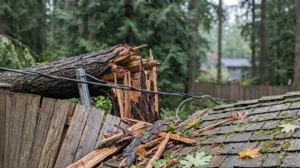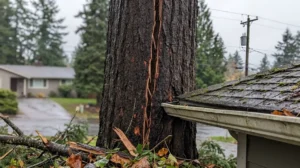
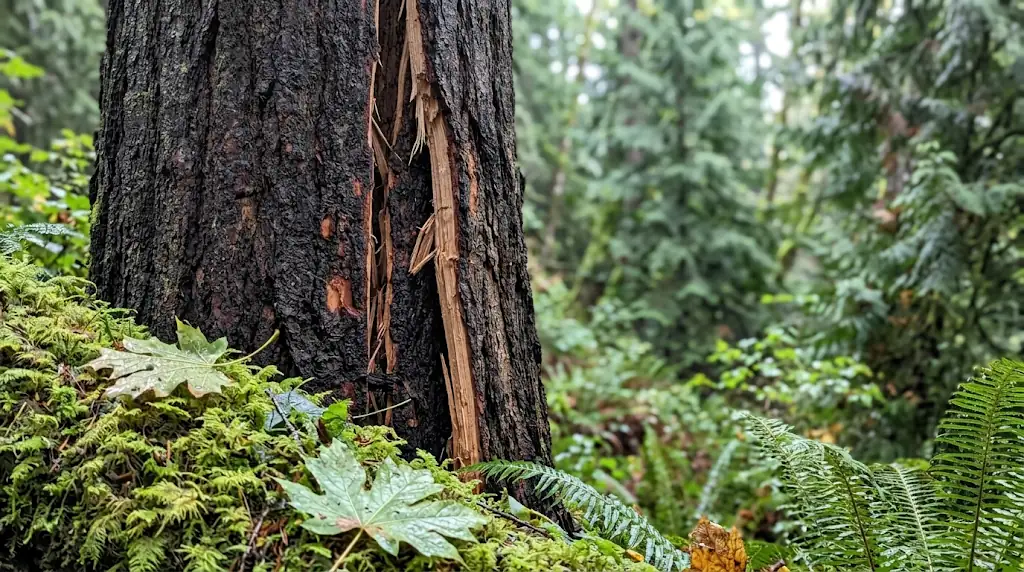
A large Douglas fir is considered hazardous when it exhibits observable structural defects—such as a lifting root plate, trunk-rot conks, deep stem cracks, or sudden crown thinning—within striking distance of a target like a home or driveway. Because Douglas firs (Pseudotsuga menziesii) can grow well over 100 feet tall and weigh upwards of 10,000 pounds, internal root rot or dead structural wood requires rapid professional evaluation before winter windstorms hit the Puget Sound.
The Douglas Fir Hazard Checklist
Douglas firs often hold green needles even after their lower trunk or root system has lost structural stability. Look for these specific warning signs from the ground up:
| Inspection Zone | Normal Condition | Warning Sign / Critical Hazard | Primary Risk |
| Ground & Root Plate | Level, undisturbed soil with a wide, visible root flare | Mounded/cracked soil on one side, exposed decayed roots, mushroom clusters | Whole-tree windthrow failure |
| Lower Trunk (Bole) | Thick, deeply furrowed, intact gray-brown bark | Bracket fungi (conks), bleeding sap, hollow sound when tapped, flat basal flare (“telephone pole” look) | Internal heartwood rot or basal shear |
| Middle Trunk | Single, straight central stem with solid wood | Co-dominant stems with “V”-shaped unions, included bark, vertical torsion cracks | Stem splitting during high wind |
| Canopy & Crown | Dense, dark green foliage throughout upper branches | Chlorotic (yellowing) needles, dead top (“spike top”), sparse foliage, heavy distress cone crop | Root failure, beetle attack, or systemic decline |
4 Major Hazards Threatening Eastside Douglas Firs
1. Laminated Root Rot (Phellinus sulphurascens)
Laminated root rot is the leading biological cause of Douglas fir failure across King County:
- How It Operates: The fungus attacks the root system from underground, breaking down the lignin between annual growth rings. Wood separates into thin, laminated sheets.
- The Danger: A Douglas fir infected with laminated root rot can maintain a relatively green canopy while its anchoring roots rot away entirely. The tree often topples cleanly at the root collar during standard 35–45 mph Puget Sound wind events without warning.
- Key Clue: Look for a lack of natural root flare at the soil line (the trunk enters the ground straight like a telephone pole) or a cluster of dying firs along your property line, as the pathogen spreads via root-to-root contact.
2. Red Belt Fungus & Velvet Top Conks
Fruiting bodies (conks) emerging directly from the bark or root collar indicate advanced interior decay:
- Velvet Top Fungus (Phaeolus schweinitzii): Also known as the “cow-pie fungus,” it grows circular, brownish-yellow brackets at the base of the tree or on the soil directly above major lateral roots. It causes severe brown cubical rot in the lower heartwood, leaving the trunk hollow and brittle.
- Red Belt Conk (Fomitopsis pinicola): Hard, shelf-like brackets with a distinct reddish-brown band and a white margin indicate dead sapwood and extensive interior rot.
3. Co-Dominant Trunks with Included Bark
Many Douglas firs in urban Eastside parcels were topped decades ago or developed twin competing leaders after early leader damage.
- The “V” vs. “U” Shape: A healthy branch junction forms a wide “U” shape with a raised bark ridge. A hazard junction forms a sharp “V” shape where bark is squeezed inward (included bark).
- Failure Mechanism: As both stems gain girth and weight, they push against each other. Pacific Northwest winter rain adds thousands of pounds of water weight to the foliage, which acts as a wedge that splits the tree down the center during windstorms.
4. Douglas-Fir Bark Beetle (Dendroctonus pseudotsugae)
Extended summer dry spells in King County stress mature firs, lowering their natural pitch defenses against native bark beetles:
- Boring Dust (Frass): Look for reddish-orange, sawdust-like powder caught in bark crevices or accumulated around the base of the trunk.
- Pitch Streams: Clear resin weeping out of small holes in the middle-to-upper trunk indicates the tree is trying to push attacking beetles out.
- Needle Discoloration: Once beetles successfully colonize the inner cambium, needles fade from yellow-green to sorrel-red across the entire crown over a 6 to 12-month period. An actively infested tree cannot be saved and must be removed to prevent beetle dispersal to adjacent firs.
Visualizing Douglas Fir Structural Integrity
                           CANOPY DEFECTS
                   [ "Spike Top" / Dying Leader ]
                                 │
             [ Distress Cone Crop / Thinning Foliage ]
                                 │
                                 │
                            TRUNK DEFECTS
                   [ Co-Dominant "V"-Crotch Stem ]
                                 │
                     [ Vertical Torsion Crack ]
                                 │
                    [ Conks / Fungal Shelves ]
                                 │
                                 │
                          ROOT ZONE HAZARDS
             [ Mounded Soil ]          [ Severed Roots ]
                    ▲                          ▲
           Lifting Root Plate          Trenching / Construction
When Is a Leaning Douglas Fir Dangerous?
Not all leaning trees are hazardous. A tree that grew with a gradual curve toward open sunlight over several decades has developed dense compression wood along its underside to support its weight naturally.
A leaning tree is critical when:
- The lean is new or has visibly shifted following a storm.
- The ground on the side opposite the lean shows freshly cracked soil, exposed fine roots, or standing water filling an indentation.
- The lean angles directly over a primary target, such as a bedroom, home office, detached structure, or power line.
Professional Hazard Evaluation (ISA TRAQ)
Determining whether a Douglas fir can be mitigated with crown cleaning and cabling—or requires complete removal—requires an International Society of Arboriculture (ISA) Tree Risk Assessment Qualified (TRAQ) arborist.
A certified TRAQ arborist uses specialized diagnostic tools to verify interior conditions before recommending removal:
- Sounding: Tapping the trunk with a non-destructive mallet to identify internal hollows and decay pockets by sound pitch.
- Resistograph Testing: Inserting a micro-drill needle into the trunk to measure resistance; drops in resistance accurately chart the precise thickness of sound wood versus rotten cavities.
- Target Rating: Measuring target occupancy rates (how often people or property occupy the impact zone) to determine legal risk ratings for city permit applications in Kirkland, Bellevue, or Redmond.
Protect Your Eastside Property from Conifer Hazards
Catching root decay and structural splits early prevents catastrophic property damage and emergency removal costs during winter storms. Kirkland Tree Removal provides thorough ISA-certified tree hazard evaluations, TRAQ permit documentation, and technical rigging for large-diameter Douglas firs across Kirkland and East King County. If you have concerns about a tall conifer near your home, schedule an on-site safety assessment through the Kirkland Tree Removal Contact Page.