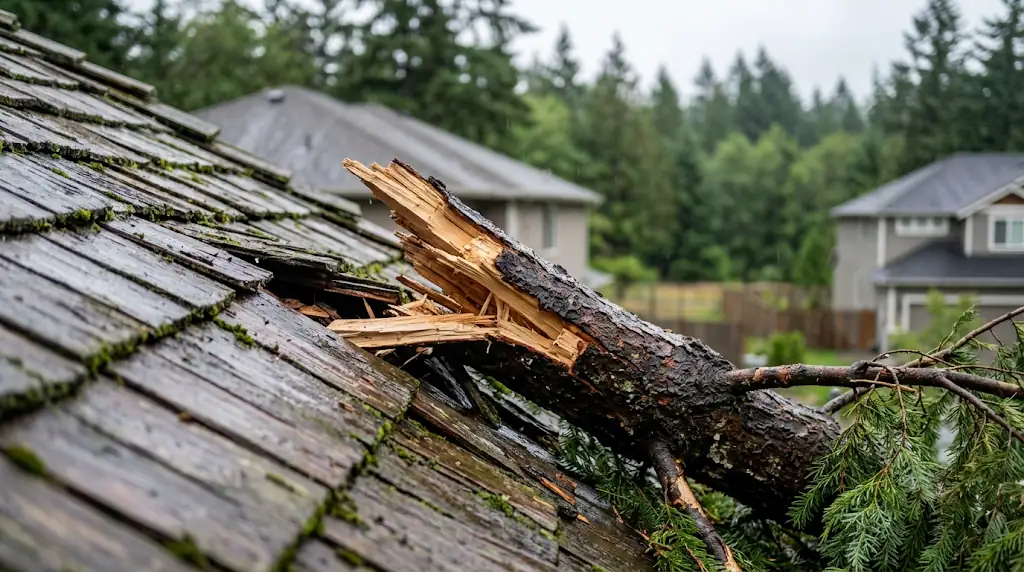
Homeowners insurance covers tree removal after a storm only if the fallen tree struck and damaged an insured structure—such as your house, garage, fence, or shed—or if it completely blocks your primary driveway. If a storm knocks down a healthy or decaying tree into an open lawn, garden, or wooded area without causing structural impact, insurance companies will pay $0 toward cutting, chipping, or hauling the debris away.
When Insurance Covers Tree Removal vs. When It Does Not
The boundary between a paid claim and an out-of-pocket bill comes down to direct physical contact with an insured property element.
| Incident Scenario | Covered by Insurance? | Applicable Policy Coverage | Typical Financial Limits |
| Tree falls onto home, roof, or garage | Yes | Coverage A (Dwelling) | Extraction covered under dwelling limits; debris hauling subject to sub-limit |
| Tree crushes detached shed, deck, or fence | Yes | Coverage B (Other Structures) | Up to 10% of standard Coverage A limit, minus deductible |
| Tree blocks main driveway or accessibility ramp | Yes (Partial) | Additional Coverage (Debris Removal) | Standard policy sub-limit applies (usually $500 to $1,000) |
| Tree falls harmlessly across lawn or open yard | No | None (Excluded) | Homeowner pays 100% of removal and disposal |
| Rotting or dead tree falls on house during a storm | Denial Likely | Excluded under Maintenance/Neglect clauses | Homeowner liable if prior decay was documented or obvious |
| Tree falls onto a personal vehicle in driveway | Homeowners: No / Auto: Yes | Auto Policy Comprehensive Coverage | Comprehensive auto deductible applies; homeowners pays nothing |
The Critical Distinction: Structural Extraction vs. Debris Removal
Adjusters frequently confuse homeowners by stating that tree removal is capped at a low flat rate. In reality, insurance contracts split post-storm tree work into two distinct billing categories:
               HOW CARRIERS ALLOCATE FALLEN TREE INVOICES
                                    │
    ┌───────────────────────────────┴───────────────────────────────┐
    ▼                                                               ▼
[ STRUCTURAL EXTRACTION ]                               [ WOOD & DEBRIS HAUL-AWAY ]
• Paid under Coverage A (Dwelling).                     • Paid under Debris Removal Sub-limit.
• Covers mobile crane mobilization,                     • Covers bucking logs into chips, loading
  technical rigging, and lifting heavy                    dump trucks, and local disposal dump fees.
  evergreen trunks off roof rafters.                    • Standard policy cap: $500 to $1,000
• No low dollar sub-limit; falls under main               per tree ($1,000 to $2,000 per storm).
  dwelling rebuild limits (minus deductible).           • Excess costs come out of pocket.
If a 90-foot Douglas fir crashes into a Kirkland roofline, the technical crane work required to stabilize and lift the trunk off the rafters to allow emergency tarping is classified as Reasonable and Necessary Mitigation under Coverage A. Only the subsequent cutting and hauling away of wood off the property falls under the restricted debris sub-limit.
What About a Neighbor’s Fallen Tree?
Severe East King County windstorms frequently push massive evergreens across property lines. Under Washington State premises liability law, whose policy responds depends strictly on fault:
- Sound, Healthy Tree: If a healthy Western Red Cedar on a neighboring property blows over onto your roof during a 50 mph Puget Sound gale, Washington law deems it an Act of God. The neighbor owes zero liability. You must file the claim through your own homeowner policy and pay your standard deductible.
- Dead or Visibly Rotted Tree: If you previously warned your neighbor in writing—ideally with an ISA-certified arborist TRAQ report—that their rotting alder or dead conifer was a hazard, the incident is classified as homeowner negligence. Your insurance carrier will pay your structural repairs and initiate subrogation against the neighbor’s insurer to recover repair costs and refund your deductible.
The Negligence Trap: Why Insurers Deny Fallen Tree Claims
Insurance policies strictly protect against sudden, accidental events (such as windstorms, lightning, and snow loading). They explicitly exclude damage stemming from deferred home maintenance.
When a storm downs a large tree in East King County, adjusters look for clear signs of pre-existing failure:
- Laminated Root Rot or Ganoderma Conks: Fungal fruiting bodies or hollow basal cavities show the tree was dead long before the wind arrived.
- Bark Beetle Damage: Extensive needle drop, sawdust frass, and dead cambium wood confirm an unaddressed infestation.
- Standing Deadwood: If a dead pine or alder snaps, the insurer will argue the homeowner neglected their duty to mitigate known property hazards, which can jeopardize the entire structural claim.
5 Steps to Take Immediately After a Storm Tree Fall
To protect your insurance claim and prevent disputes over emergency tree invoices, follow this sequence:
Step 1: Verify Life Safety & Clear the Zone
   └─ Ensure everyone is clear of the impacted structure. Treat any downed wires
      as live and contact Puget Sound Energy (1-888-225-5773) immediately.

Step 2: Document Everything Before Touching the Wood
   └─ Capture wide-angle and close-up photos of:
        • The tree on the damaged structure.
        • The root plate (to prove whether the roots failed in wet soil).
        • Fresh wood at the fracture site to prove the tree was alive.

Step 3: Call a Licensed, Bonded, and Insured Tree Service
   └─ Hire an arborist experienced in insurance billing. Never hire out-of-state
      door-to-door crews lacking Washington L&I tree care coverage.

Step 4: Request an Itemized Invoice Format
   └─ Have the contractor explicitly split the bill:
        • Line Item 1: Crane/Rigging to extract the tree off the building (Coverage A).
        • Line Item 2: Off-site debris processing, chipping, and hauling (Debris Sub-limit).

Step 5: File the Claim Promptly
   └─ Provide your insurer with time-stamped weather reports from local Eastside
      stations documenting wind gust speeds during the failure event.
Running the Deductible Math: When NOT to File a Claim
Small tree removal claims often cost more in future premiums than the payout is worth.
For example, if high winds snap a 40-foot birch that crushes a section of cedar fence:
- Fence replacement cost: $1,400
- Tree removal and hauling cost: $700
- Total cost: $2,100
- Standard homeowner policy deductible: $1,500
- Net insurance payout: $600
Filing a claim for a $600 net check will place an incident on your Comprehensive Loss Underwriting Exchange (CLUE) report, potentially increasing your annual insurance premiums for the next 3 to 5 years. As a general rule, self-fund minor fence or outbuilding tree repairs and reserve insurance claims for catastrophic structural roof and wall impacts.
Professional Storm Tree Extraction & Documentation
Navigating fallen timber, structural safety, and complex insurance line-item allocations requires experienced technical arborists. Kirkland Tree Removal delivers emergency tree extraction, crane-assisted dismantling, and detailed insurance-ready documentation across Kirkland, Bellevue, Redmond, and surrounding East King County communities. To request rapid storm damage response or on-site hazard evaluations, contact our team directly through the Kirkland Tree Removal Contact Page.