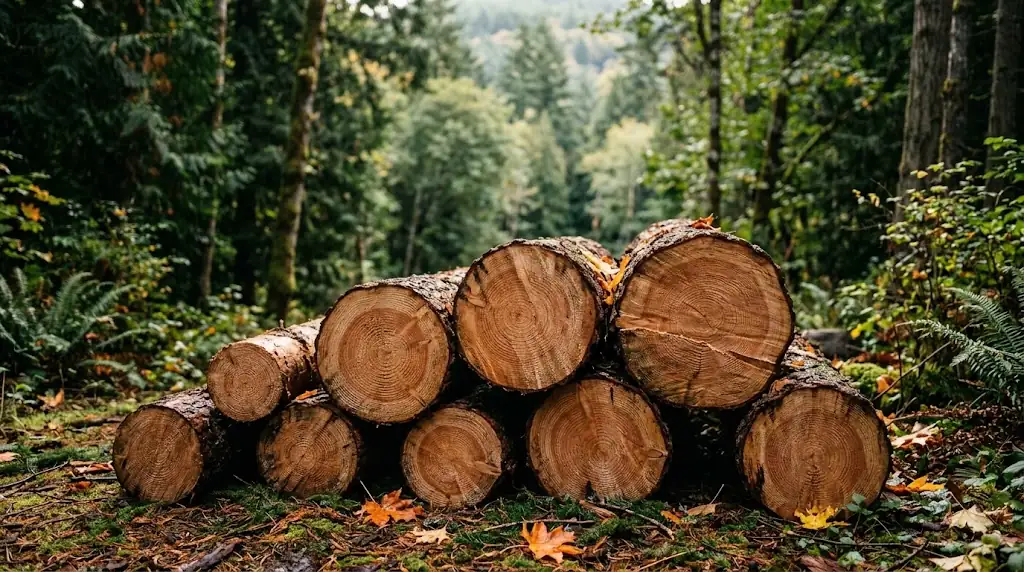
Tree removal in East King County costs between $450 and $4,800 on average, with most residential projects landing between $1,200 and $2,600. Final pricing depends strictly on overall tree height, trunk diameter, proximity to structures or overhead power lines, and the specific municipal permit and disposal requirements in your city.
Average Tree Removal Costs by Size in East King County
Height and trunk diameter are the primary baselines tree services use to calculate labor hours, rigging requirements, and equipment overhead.
| Tree Size Category | Height Range | Typical Trunk Diameter (DBH) | Common Eastside Species | Average Price Range |
| Small | Under 30 feet | Under 10 inches | Vine Maple, Japanese Maple, Dogwood, Fruit Trees | $450 – $850 |
| Medium | 30 to 60 feet | 10 to 20 inches | Red Alder, Birch, European Mountain Ash | $850 – $1,750 |
| Large | 60 to 100 feet | 20 to 36 inches | Western Red Cedar, Bigleaf Maple, Hemlock | $1,750 – $3,200 |
| Extra-Large / Dangerous | 100+ feet | 36+ inches | Old-Growth Douglas Fir, Cottonwood | $3,200 – $6,500+ |
Key Factors That Dictate Tree Removal Pricing in the Eastside
Standard national averages do not reflect East King County real estate realities. Several regional variables drive local costs:
1. Site Access and Target Obstacles
- Zero Lot-Line Clearances: Modern developments in areas like Kirkland’s Totem Lake or Bellevue’s Spring District feature tight side yards. If a crew cannot bring heavy machinery like a bucket truck or spider lift into the yard, arborists must climb and rig down limbs manually piece by piece, increasing labor time by 40% to 75%.
- Lake Washington & Cougar Mountain Slopes: Homes situated on steep inclines or waterfront bluffs require specialized high-angle rigging, zip lines, or crane picks to lift sections uphill to the road, adding $1,000 to $2,500 in specialized equipment operation.
2. Proximity to Puget Sound Energy (PSE) Utility Lines
Working within 10 feet of energized lines requires an electrical-hazard certified arborist. If Puget Sound Energy needs to temporarily drop a service line or if specialized insulated aerial equipment is required, coordination and safety protocols add to the total project cost.
3. Species-Specific Wood Density and Branch Spread
- Douglas Fir & Western Red Cedar: These straight-trunk conifers require vertical piecing and heavy-capacity lowering lines due to green log weight (green Douglas fir weighs approximately 38 to 42 lbs per cubic foot).
- Bigleaf Maple: Multi-stem, broad-canopy maples require multiple rigging tie-in points and produce massive brush volume that fills wood chippers quickly, raising hauling fees.
- Black Cottonwood: High water content, brittle wood fibers, and sudden branch-drop risks make cottonwood removal technically hazardous, frequently requiring crane-assisted picks.
Breakdown of Add-On and Auxiliary Services
Complete tree removal often involves more than just dropping a trunk to grade level.
| Service Item | What It Includes | Typical East King County Cost |
| Stump Grinding | Grinding the stump 6 to 12 inches below grade | $150 – $500 (or $3 to $5 per diameter inch) |
| Wood Chipping & Haul-Away | Processing brush and taking wood chips off-site | $200 – $600 per load |
| Log Splitting / Stacking | Cutting trunk sections into 16″ firewood lengths on-site | $150 – $350 |
| TRAQ Arborist Assessment | Official written hazard report for municipal permit filing | $250 – $600 |
| City Tree Removal Permit Fees | Municipal plan review fees (Kirkland, Bellevue, Redmond) | $100 – $400 |
| Emergency Storm Callout | Immediate after-hours response for fallen or hung-up trees | $500 – $1,500+ dispatch surcharge |
Crane-Assisted Removals: When Are They Required?
When a mature 90-foot conifer leans over a residential roofline, deck, or sensitive shoreline buffer, manual dismantling is often unsafe or structurally impossible.
In these cases, tree services use mobile hydraulic cranes:
                  CRANE VS. MANUAL RIGGING COST PROFILE

   [Manual Rigging: Tight Access]       [Crane-Assisted Removal]
   • Crew: 3-4 Climbers & Ground crew   • Crew: 4-5 Specialists + Operator
   • Time: 8 to 12 Hours                • Time: 3 to 5 Hours
   • Risk: Drop zone damage hazards     • Risk: Controlled aerial pick
   • Cost: $2,200 – $3,800              • Cost: $3,500 – $6,500 (incl. crane fee)
Crane rentals in the Seattle-Bellevue metro typically run on 4-hour minimums starting at $1,200 to $1,800, but they cut site disruption significantly and eliminate the risk of dropping massive logs onto manicured landscapes or structures.
Does Homeowners Insurance Cover Tree Removal?
East King County property owners often wonder if policy coverage will offset removal costs following Pacific Northwest windstorms. The rules are clear:
- Tree Hits an Insured Structure (House, Garage, Shed): Insurance generally covers tree removal from the structure, plus structural repair, subject to your policy deductible (coverage typically caps tree debris removal at $500 to $1,000 per tree).
- Tree Falls in the Yard Without Damaging Structures: Standard policies do not cover removal or cleanup if the tree falls harmlessly on a lawn, garden, or open driveway.
- Preventative Removal of a Dead or Rotting Tree: Insurance policies never cover preventative maintenance. If an unmaintained hazard tree falls, the insurance company may deny the claim due to owner negligence.
4 Red Flags to Avoid When Reviewing Tree Service Bids
Unusually low estimates in East King County often mean the contractor is cutting corners on required coverage or licensing:
- No Proof of Worker’s Comp (L&I): Washington State Department of Labor & Industries requires tree trimmers to carry high-risk manual labor coverage. An uninsured tree fall puts full medical and property liability directly on the homeowner.
- Door-to-Door Canvassing After Windstorms: Out-of-area storm chasers frequently quote cash jobs without local city business licenses, knowledge of KZC Chapter 95 tree codes, or valid bonded status.
- No Tree Risk Assessment Qualified (TRAQ) Credentials: If you submit an arborist report signed by an uncertified contractor to Kirkland or Redmond planning departments, your permit will be rejected.
- “Topping” Offered Instead of Proper Removal: Tree topping violates ANSI A300 pruning standards, leaves hazardous decay columns, and is legally penalized under municipal canopy preservation codes.
Get an Accurate, Upfront Estimate for Eastside Tree Removal
Every parcel on the Eastside has unique access points, soil conditions, and municipal canopy rules that influence final costs. Kirkland Tree Removal delivers transparent, itemized quotes covering technical removal, ISA TRAQ arborist reports, city permit filing, and complete stump elimination. To schedule an on-site evaluation for your residential or commercial property, connect with our team through the Kirkland Tree Removal Contact Page.