An emergency tree removal in East King County is defined by municipal code as the immediate removal of a tree that poses an imminent, verifiable hazard to human life, active structures, or critical public infrastructure. Under these specific emergency conditions, property owners can bypass the standard multi-week permit application and remove the hazard immediately, provided they document the failure and file retroactive paperwork within city deadlines.
The Legal Threshold: “Imminent Hazard” vs. Routine Hazard
East King County cities (Kirkland, Bellevue, Redmond) and King County Permitting draw a strict legal distinction between a dangerous tree and an emergency tree.
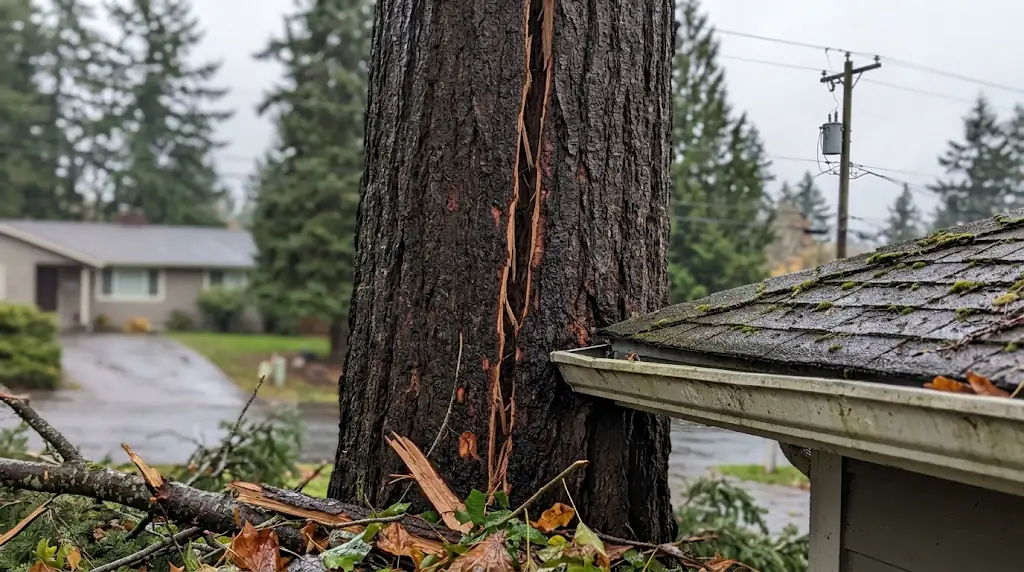
- An Imminent Emergency: Structural failure is underway or unavoidable within hours or days. The tree has already partially failed, its root plate is lifting, or it has suffered severe structural splintering directly over a target (such as a roofline, driveway, or power line).
- A Standard Hazard Tree: A tree displays chronic disease, interior rot, heavy canopy lean, or pest infestation, but its root plate is stable and trunk wood retains structural integrity. Standard hazard trees still require standard tree removal permits supported by an ISA Tree Risk Assessment Qualified (TRAQ) arborist report before any work begins.
┌────────────────────────────────────────────────────────────────────────┐
│                        EMERGENCY CLASSIFICATION                        │
├───────────────────────────────────┬────────────────────────────────────┤
│ QUALIFIES AS AN EMERGENCY         │ DOES NOT QUALIFY (PERMIT FIRST)    │
├───────────────────────────────────┼────────────────────────────────────┤
│ • Freshly uprooted root plate     │ • Standing dead tree with no       │
│   heaving soil after a storm      │   immediate structural target      │
│ • Split or fractured main trunk   │ • Tree leaning toward a home for   │
│   threatening a home or garage    │   years without fresh soil movement│
│ • Tree or large limb resting on   │ • Dying tree dropping minor twigs, │
│   a structure or service line     │   needles, or small deadwood       │
│ • Hanging, fractured limb (widow- │ • Tree roots breaking up a garden  │
│   maker) over high-traffic areas  │   retaining wall or sidewalk slab  │
└───────────────────────────────────┴────────────────────────────────────┘
East King County Emergency Conditions: What Qualifies
1. Root Plate Lifting and Soil Mounding
Pacific Northwest winter storms frequently drop several inches of rainfall across King County, saturating clay soils. When high windstorms hit the Eastside, shallow-rooted species like Douglas Fir and Western Red Cedar experience root slippage. If the soil on the side opposite the lean is visibly mounded, cracked, or lifting out of the ground, the root plate has failed. This is an active structural emergency.
2. Deep Stem Splits and Trunk Torsion
Heavy gusts twisting a dense evergreen canopy create severe shear forces along the trunk. Fresh vertical cracks oozing sap, split co-dominant stems, or fractured heartwood indicate imminent collapse.
3. Hung-Up Trees and “Widowmakers”
A tree that snapped at the mid-trunk and is currently suspended in the canopy of an adjacent tree is an imminent life-safety hazard. The friction supporting the hung-up trunk can give way at any moment without warning.
4. Direct Impact on Residential Structures or Primary Access
A fallen or wedged tree resting on an occupied dwelling, detached garage, or sole-access driveway (blocking emergency medical or fire egress) meets every municipal criteria for emergency intervention.
Retroactive Filing Deadlines by Eastside Jurisdiction
Bypassing standard review does not exempt property owners from city tree canopy laws. To qualify as an exempt emergency removal, you must notify the city and provide evidence within a mandatory post-removal window:
| Eastside Jurisdiction | Governing Code | Notification Window After Removal | Required Documentation |
| City of Kirkland | KZC 95.20(1) | Within 7 calendar days | Time-stamped failure photos, arborist hazard statement |
| City of Bellevue | BCC 23.76 & LUC 20.20.900 | Within 7 to 14 days (prompt notice) | Photos of damage/target, TRAQ arborist evaluation |
| City of Redmond | RMC 21.72.050 | Within 7 calendar days | Photo evidence of failure, replanting confirmation |
| Unincorporated King County | KCC 16.82.051 | Within 21 calendar days | Emergency clearing notification, site plan |
Step-by-Step Protocol During an Eastside Tree Emergency
Failing to properly document an emergency removal exposes property owners to significant tree code fines, which can exceed $1,000 per diameter inch in Kirkland. Follow this operational sequence:
Step 1: Clear the Impact Zone
   └─ Evacuate areas beneath the lean or target radius immediately.

Step 2: Take Clear, Time-Stamped Photos
   └─ Capture 3 angles:
        1. Close-up of the failure point (fracture, lifted root plate).
        2. Wide shot showing the tree's relationship to the threatened structure.
        3. Entire tree context including neighboring properties.

Step 3: Call an ISA-Certified Tree Contractor
   └─ Dispatch a crew with heavy rigging/crane capability and emergency insurance.

Step 4: Secure a Written TRAQ Arborist Memo
   └─ Ensure the arborist records the specific structural failure and hazard rating.

Step 5: Submit the Retroactive City Filing
   └─ File the emergency notification through MyBuildingPermit.com or city portal.
What Happens if the City Rejects the Emergency Claim?
City urban forestry officials review retroactive emergency applications against submitted photographic and arborist records.
If municipal code compliance officers determine that the tree was simply dying or nuisance-grade rather than an imminent threat, the removal is reclassified as an unauthorized removal. Penalties include:
- Severe Civil Fines: Kirkland and Bellevue assess penalties based on tree diameter or full CTLA replacement value (which can reach tens of thousands of dollars for mature conifers).
- Compulsory Replacement Ratios: Homeowners may be legally forced to plant up to 3 mature replacement trees on the lot for every unauthorized landmark tree removed.
- Title Notices: Outstanding code violations are attached to King County property records, preventing future building permits or property sales until resolved.
Rapid Emergency Tree Response in East King County
When high-wind storms or saturated soils compromise mature trees on your property, acting quickly and compliantly is critical. Kirkland Tree Removal provides emergency tree removal, high-risk technical rigging, and post-hazard arborist documentation that satisfies Kirkland, Bellevue, and King County code standards. To report an active tree hazard or schedule rapid structural assessment, reach out immediately via the Kirkland Tree Removal Contact Page.